
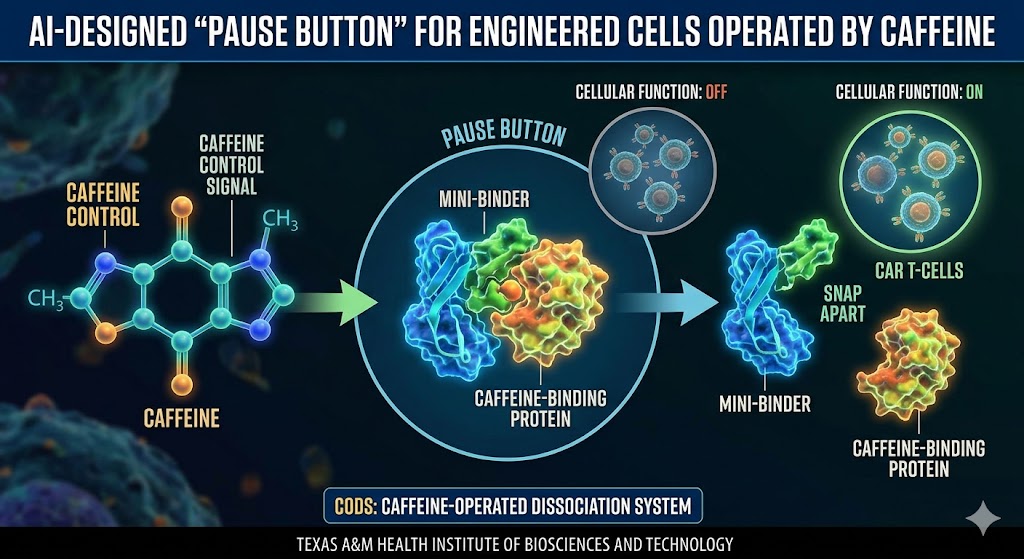
Researchers at the Texas A&M Health Institute of Biosciences and Technology have developed CODS (caffeine-operated dissociation system), an AI-designed molecular "pause button" that uses caffeine to control engineered cells. Published in the Journal of the American Chemical Society, the study details how the team used the BindCraft platform and high-performance computing to create a synthetic mini-binder that locks with a caffeine-binding protein. When caffeine is introduced, the complex snaps apart, halting specific cellular functions.
Led by senior author Yubin Zhou, MD, PhD, the team successfully demonstrated CODS across multiple biological contexts. It successfully reduced transcriptional activity in gene circuits, triggered inflammatory cell death in a rewired pyroptosis pathway, and temporarily dampened CAR T-cell activity.
While caffeine itself is not a medicine, its established safety and familiarity make it an ideal, accessible control signalfor making programmable cell therapies safer and more responsive. Moving forward, the researchers plan to test CODS in animal models and disease-relevant settings. Texas A&M University has filed a provisional patent application for the platform, which serves as a blueprint for future AI-designed molecular switches responsive to everyday molecules.