
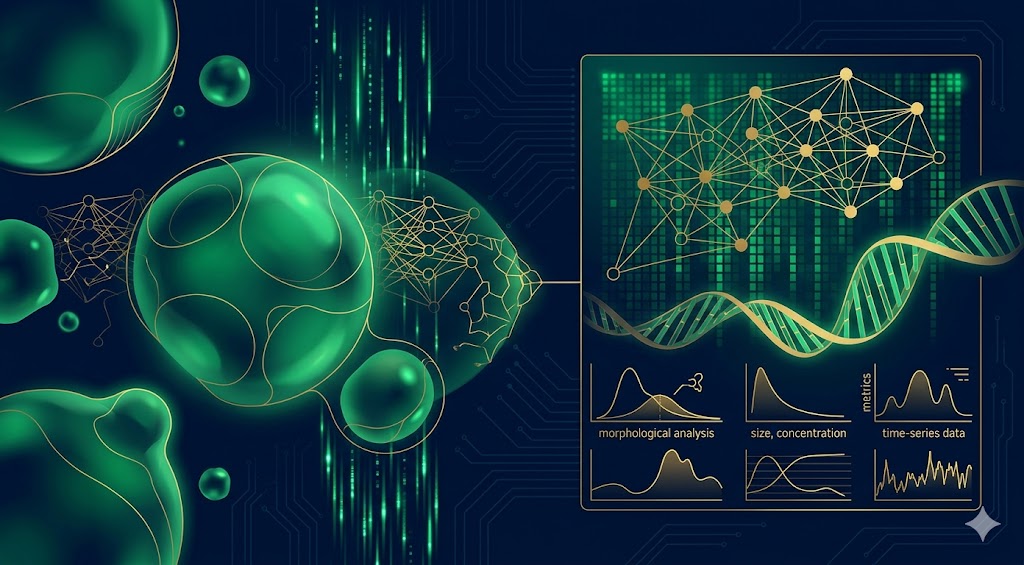
A pioneering study published in the journal Cell introduces Deep-Phase, a novel neural-network-based artificial intelligence framework designed to decode how pharmaceutical compounds perturb biomolecular condensates inside living cells. Developed by a research team led by Dr. Clifford Brangwynne at Princeton University, the technology directly bridges the gap between molecular-level interactions and cellular mesoscale organization.
Biomolecular condensates, such as the nucleolus, compartmentalize cellular interiors to manage complex functions. Historically, identifying how drugs affect these delicate, liquid-like structures was bottlenecked because human analysis easily overlooks subtle architectural features beyond basic size and shape. Deep-Phase resolves this by using deep learning to autonomously analyze high-resolution microscopy images, precisely quantifying time - and concentration-dependent morphological variations.
In a live chemical screen, the AI successfully mapped structural perturbations to drug potencies inhibiting ribosomal RNA transcription. Remarkably, Deep-Phase independently uncovered an entirely unrecognized nucleolar morphology, revealing a hidden role for a DNA topoisomerase in RNA processing. The authors emphasize that Deep-Phase is highly adaptable across diverse cell lines and labeling techniques, providing the broader biomedical community with a powerful computer-vision platform to fast-track targeted drug discovery.