
Beyond Results: AI and the Work of Becoming
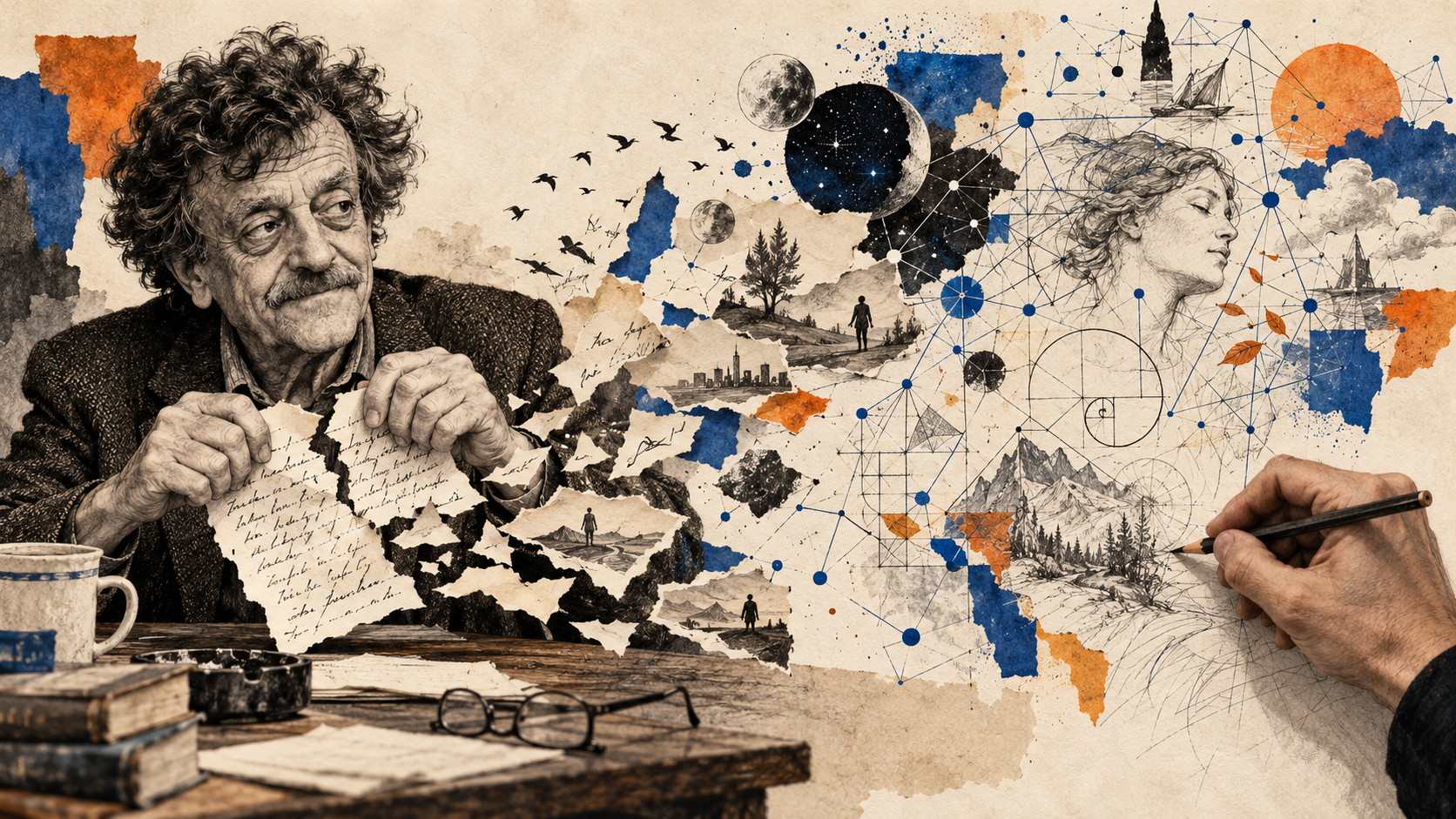
In November 2006, 84-year-old Kurt Vonnegut received a letter from students at a New York high school inviting him to visit. He declined, but gave them an unusual assignment: write a six-line rhyming poem, show it to no one, then tear it into tiny pieces and throw it away. Why go to all that trouble just to fill a wastebasket? Vonnegut explained that we should make art not for money or fame, but "to experience becoming, to find out what's inside you, to make your soul grow." The poem itself was beside the point. Even if it ended up in the trash, its author had gained something that could not be thrown away.
Twenty years later, this idea has become surprisingly relevant to the future of AI. Recent progress in mathematics gives us a good reason to think about it. After achieving gold medal level performance at international mathematics competitions, AI systems have started solving research problems that had puzzled mathematicians for decades. In May 2026, OpenAI reported that one of its models had found new configurations of points that disproved a longstanding conjecture related to Erdős's unit distance problem. In September, the company presented a proposed solution to the Navier–Stokes problem, one of the famous Millennium Prize Problems. Then, on October 6, OpenAI released 722 mathematical manuscripts covering 372 families of results, many accompanied by formal proofs in Lean, a system for computer verification of mathematical proofs. Of course, mathematicians still need to examine the correctness, originality, and significance of these results. But the change is hard to miss. AI can now produce mathematical results that have never appeared in the research literature.
These developments have sparked a serious debate among mathematicians. In June 2026, the Leiden Declaration on AI and Mathematics called for responsible use of AI in research. On September 11, a group of Fields Medal winners published an open letter, A Severe Misalignment of AI in Mathematics. Its authors argue that solving mathematical problems is a means to a larger goal: developing mathematical understanding. Mathematics advances through new ideas, methods, intuition, and the training of new generations of researchers, as well as through new proofs. Oxford professor Leslie Ann Goldberg addressed this problem particularly forcefully in her essay Mathematics and AI, published on September 28 and updated on October 7, 2026. Her concern is not that AI will destroy mathematics itself, but that it may undermine the human infrastructure we have built for understanding it. Suppose a machine can solve in minutes a problem that might have occupied a PhD student for years. That's wonderful news for getting the problem solved. But what happens to the PhD student? How do young mathematicians develop the intuition, judgment, and research experience that used to come from years of struggling with difficult problems? And how can the growing mountain of AI-generated proofs be transformed into growth in human understanding?
This brings us back to Vonnegut and becoming. Until recently, producing intellectual work and developing one's intellectual abilities were closely connected. To prove a theorem, write a research paper, or build a complex argument, you had to spend time struggling with the problem, following approaches that led nowhere, revising your assumptions, and occasionally discovering something unexpected. Now we can get excellent results without necessarily understanding very much about how they were obtained. When I say “how” I don’t mean the exact logic of the mathematical proof but rather which inner intellectual skills would have to be engaged to come to this logic. The same issue extends far beyond mathematics, to the natural sciences, humanities, social sciences, and arts. If AI can take over a growing share of our intellectual and creative work, what happens to us? Which of our abilities will weaken, which will develop, and which new ones might emerge? And can AI itself help us preserve and expand our capacity to understand ourselves and the world?
In principle, AI can already help us develop that understanding. It can examine our hypotheses, look for contradictions, challenge assumptions, and suggest alternative interpretations. Unfortunately, its criticism is often rather mechanical. It may produce a perfectly organized list of objections without identifying anything that a competent researcher would find particularly interesting. No wonder researchers are not always eager to ask for more of it. And there is another problem. Academic institutions reward publications, grants, measurable output, and meeting deadlines. Researchers under this pressure have every reason to use AI to get work done faster, rather than spend additional time questioning their own arguments. The challenge, then, is not simply to improve AI's critical abilities. We also need ways of working with AI that make serious intellectual engagement possible within the realities of research, including collaboration that helps people develop ideas rather than simply deliver finished products.
Some interesting experiments are already underway. Proof Commons provides a public space where mathematicians and AI agents can contribute to problems and submit proofs for formal verification. MIRA is developing an architecture in which research is organized around connected questions, claims, and evidence rather than finished papers alone. Lightcone Research at Berkeley and CNRS is building tools for documenting the decisions, evidence, and methods behind AI-assisted research. These projects offer different starting points for a more ambitious research infrastructure, where people and AI could work together on unfinished ideas and turn machine-generated results into shared human understanding. Of course, not every researcher will want to publish an unfinished argument or share confidential data. Protecting unpublished work, controlling access, and establishing priority and authorship will have to be part of the design, not an afterthought. Much of this collaboration may need to happen within private research groups, with researchers deciding what to share and when.
Finally, we need to rethink how we judge the success of AI tools. Speed, accuracy, and the quality of the final product tell us a great deal about what AI can do, but much less about what happens to the person using it. And perhaps no external benchmark can adequately measure something as personal and complex as becoming. Each of us has to ask: Did working with AI help me understand something I could not understand before? Did I develop a new idea, acquire a new ability, or discover a question I would otherwise have missed? Or did I simply get the work done faster? Answering these questions requires intellectual honesty and personal responsibility. Developers, meanwhile, face a different challenge: building AI architectures and modes of interaction that offer more opportunities for such growth, including new forms of collective research. The sooner we take this challenge seriously, the better our chances of preserving and expanding human intellectual capacities, perhaps in ways we cannot yet imagine.
