
Wag the Dog, or Who we are when we write with AI
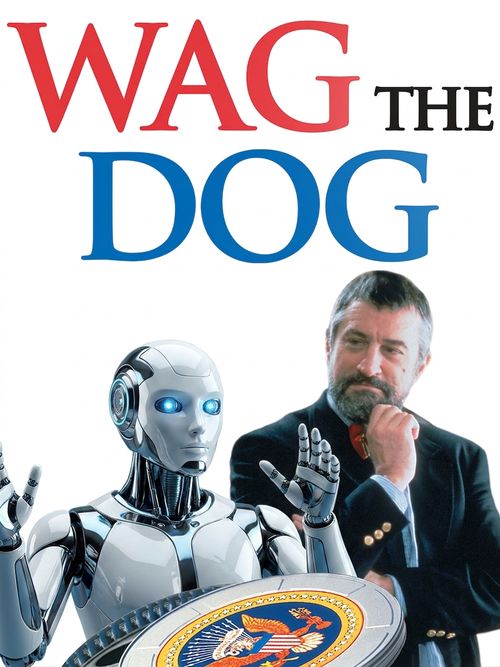
Most of us who write professionally care about style, about how our prose sounds and reads. We want to preserve our voice. And still we turn to AI for help. The reasons vary: sometimes we need it to locate sources we are not aware of, sometimes to structure raw data and the preliminary analytical conclusions we have drawn from it, sometimes to overcome a “creative block,” the inability to write when the mind locks up. Sometimes we have plans that resist to become cohesive texts, sometimes we face assignments so layered in scope that the sheer complexity stalls the first sentence. Whatever the reason, the way we work with AI always turns into a series of numerous interactions, reiterations, corrections, restarts.
I recently came across a very interesting description of collaboration with AI. It was included in the book of a famous futorologist Jamie Metzl released in official co-authorship with ChatGPT-5. The AI Ten Commandments: A New Moral Code for Humanity attracted me because it is one of a still small number of non-fiction books co-authored with AI. Their collaboration, as Metzl puts it, was "iterative and layered." Sometimes he would write an introductory sentence and ask GPT-5 for a few paragraphs, then rework them. Sometimes he would write an entire paragraph and ask GPT-5 to rewrite it "perhaps five different times" in his own style, picking one version to edit further. They went through this cycle "thousands of times over the course of drafting the book, each cycle deepening the quality and clarity of the ideas." What emerges from this account is a picture of relentless back-and-forth where neither side works in isolation and no output is ever accepted wholesale.
Does this description sound familiar?
Metzl suggests a metaphor for this kind of collaboration: co-piloting. He compares AI's current role to digital systems in aviation that optimize flight paths and adjust for weather in real time, or to algorithms in medical radiology that flag anomalies in scans for a human specialist to evaluate. In this model, the human author always maintains control and preserves their unique biographical and authorial "I," while ChatGPT provides its own contributions only when asked and within the boundaries the human sets.
I would suggest that the process of co-authorship is more complex than this model allows. Multiple interactions with AI, the sheer accumulation of reiterations, force us to review assumptions we did not know we held. They require us to formulate in explicit language what was previously implied only intuitively, to revisit research hypotheses we considered settled, to listen more attentively to our own voice and look more closely at the way we present ourselves. To tell an AI what you want, you first have to know what you want, and many of us discover in that moment that we did not. You find mid-conversation that your tone has drifted, that a framework you trusted no longer holds, that the effort of instructing the AI has quietly surfaced a better question than the one you started with.
I suggest another metaphor that perhaps defines our interaction with AI more precisely.
Imagine that you have a young colleague or a graduate student of extraordinary, almost unsettling talent, the kind you will never develop in yourself, no matter how many years you have on them. This person can process and cross-reference material at a speed and breadth that would take you months. At the same time, they require very attentive guidance. They sometimes fail at tasks you consider simple. Their rigidity on certain points drives you to frustration, occasionally to something close to quarreling. And yet working with them regularly forces you to do things you would not otherwise do: completely review a conclusion you felt confident about, reformulate a starting point, pose a research question you had not considered. You find, sometimes uncomfortably, that conversations with this person clarify your own mission and reshape your next steps.
But the roles can also reverse, with the human author as the student and AI as the professor. In this version, AI is the one with decades of accumulated patterns, an enormous but rigid memory, and settled habits of thought. The human is the one who sees connections, proposes new formulations, pushes against resistance. And yet it is precisely this resistance, AI's stubborn literalness, its refusal to guess what you mean, that forces the human to rethink what they actually meant in the first place.
Both versions coexist in any sustained interaction with AI, sometimes within the same working session. What remains constant across both is that the interaction changes us: our assumptions, our concepts, the very authorial "I" we brought to the task. AI helps us write, and in the process, it helps us become different thinkers.
